
Artikkelit
16.12.2025
RIE2030 asettaa Singaporen tutkimus-, kehitys- ja innovaatiotoiminnalle uudet kansalliset painopisteet
What exactly are Singapore’s plans for the next five years, and what lessons might be drawn for Finland?
On 5 December 2025, Singapore’s government unveiled its latest five-year research and innovation strategy, Research, Innovation and Enterprise 2030 plan (RIE2030), outlining a record S$37 billion investment in science, technology and innovation from April 2026 to March 2031. This commitment, equivalent to roughly 1 % of the country’s GDP, continues Singapore’s long-term policy of sustained R&D investment.
At the RIE2030 press conference, Senior Minister Lee Hsien Loong, Chair of the Research, Innovation and Enterprise Council, emphasized that research and innovation will grow in importance as the economy matures, noting the need to sustain R&D investment through “thick and thin.” Professor Tan Chorh Chuan, Permanent Secretary for National Research and Development, highlighted that the new RIE “focuses on things that improve our economy, effectiveness, and our competitiveness.”
Focus through strategic instruments: Flagships and Grand Challenges
RIE2030 retains the four major national domains established in the earlier RIE2025 plan (Manufacturing, Trade & Connectivity; Human Health & Potential; Urban Solutions & Sustainability; and Smart Nation & Digital Economy). A structural change is that innovation and enterprise activities are now more tightly embedded within each domain, rather than treated as cross-cutting components.
Arguably, the most substantial addition to the strategy is the introduction of RIE Flagships & Grand Challenges, which are large cross-cutting programmes designed to align R&D portfolios with strategic national goals and economic opportunities. Two themes for these programmes were revealed on December’s press conference. Flagships are designed around selected economic sectors, with the first focusing on semiconductors, including research areas such as advanced packaging, photonics and heterogeneous integration. The stated objective is to strengthen Singapore’s position within global semiconductor value chains.
Grand challenges are oriented toward longer-term national strategic priorities. The first one addresses active ageing, as by 2030 a quarter of Singaporeans are projected to be 65 or older. Similar themes have been discussed within Finnish and Nordic research policy, particularly in relation to healthcare systems, workforce participation and societal resilience.
White space funding for surprising developments
Apart from the national domains, RIE2030’s notable budget will also go to foundational research (24 per cent), innovation and enterprise (20 per cent), as well as talent development (10 per cent). As usual, Singapore is also preparing for the unexpected. Repeating the allocations for unexpected developments from its predecessor RIE2025, the RIE2030 plan also includes a hefty sum for surprises, with 6,4 billion SGD (17 per cent).
Another noteworthy element is a broader approach to research impact assessment. The plan emphasizes a “basket of parameters” for judging research success, which goes beyond purely commercial outputs to include research quality, collaboration depth and real-world applicability. Professor Tan has underlined the intention to transition toward more qualitative indicators, such as cross-sector partnerships, interdisciplinary impact, and contribution to long-term policy objectives. At the same time, implementing such approaches consistently and transparently remains a recognized challenge.
New openings for international collaboration
Announced in conjunction with RIE2030 were also some new additions to Singapore’s international collaboration toolkit. The newly announced Singapore–Horizon Europe Complementary Fund supports Singapore-based researchers participating in Horizon Europe projects by providing national co-funding alongside EU grants.
The mechanism aligns Singapore’s R&D investments with EU research priorities and reduces administrative barriers to EU–Singapore collaboration, though the scale and long-term impact of the fund will depend on uptake and alignment with Horizon Europe calls.
A familiar strategy, sharpened for impact
Despite retaining the same major national domains from RIE2025, Senior Minister Lee has emphasized that RIE2030 is designed not merely to continue prior strategies, but to sharpen missions and outcomes in a more focused and value-oriented way.
RIE2030 reinforces Singapore’s long-standing commitment to research and innovation, but does so with perhaps clearer priorities, and a significantly larger funding envelope than RIE2025. The introduction of national flagships and grand challenges signals a shift toward more mission-oriented, outcome-focused research, while sustained investment in basic science and talent reflects confidence in long-term capability building.
Overall, the plan suggests a more selective and strategic use of public R&D funding in an increasingly competitive global environment. At the same time, some critics have noted that mission-oriented instruments may concentrate funding on a narrower set of priorities, potentially raising questions about flexibility and the space available for bottom-up research initiatives outside defined missions.
For Finland, many of RIE2030’s focus areas (AI and data, advanced manufacturing, healthy ageing and sustainability) resonate strongly with national and EU-level R&D priorities. While the two countries operate in different scales and systems, the underlying logic is similar: strengthening resilience, productivity and societal wellbeing through targeted research and innovation. International partnering is a key element in achieving this goal.
Teksti ja kuva Roosa Minkkilä, Suomen edustusto Singaporessa
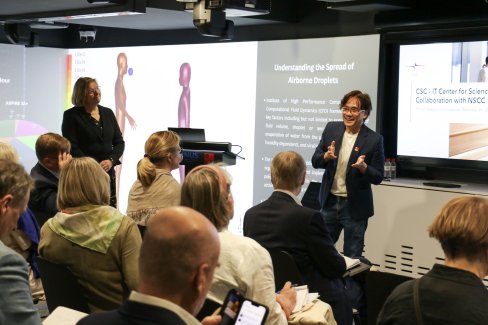
Kuva: Tutkimus- ja innovaationeuvoston ja Sitran vierailu Singaporessa